If you’re sourcing stainless steel insulated water bottles from overseas, you’ve probably asked yourself this question more than once: What exactly should I be checking when the goods come off the production line?
We would like to share a solid inspection checklist isn’t just about catching defects. It’s about protecting your brand reputation, keeping your customers safe, and avoiding those nasty surprises when containers land at your warehouse.
Let me walk you through what actually matters when inspecting stainless steel insulated water bottles.
First Things First – The Standards You Need to Know
Different markets have different requirements. Here’s what typically applies:
– Europe: EN 12546-1-2000 – Materials and articles in contact with foodstuffs
– China: QB/T 2332-1997 – Stainless steel vacuum flasks
– South Korea: KS G 3200 – Stainless steel thermos bottles
These standards cover everything from material safety to thermal performance. Your supplier should be able to provide test reports showing compliance with the relevant standards for your target market.
Material Safety – The Non-Negotiable Stuff
Before we even talk about how the bottle looks or performs, we need to talk about what it’s made of.
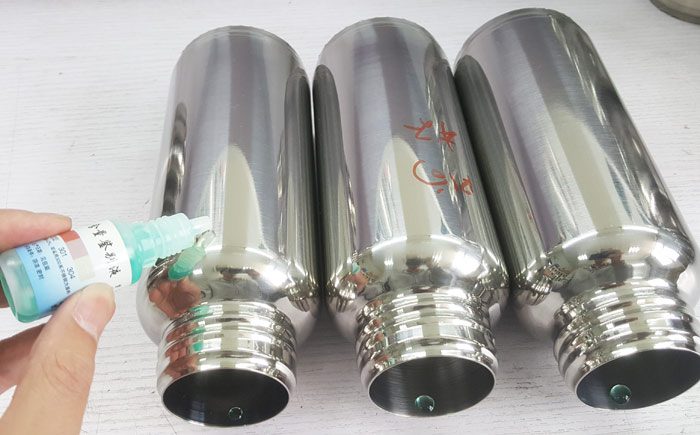
**Stainless steel** – You want food-grade 304 (18/8) or 316 stainless steel for the interior. Check that the supplier can provide material certificates. Some cheaper bottles use 201 stainless steel, which can rust over time and isn’t considered food-safe in many markets.
**Plastic components** – Lids, drinking spouts, and rings need to be made from food-grade plastics (polypropylene is common). They should be BPA-free and compliant with FDA or LFGB requirements.
**Silicone seals** – The sealing ring inside the lid should be food-grade silicone. It shouldn’t have any strange smell – that’s often a red flag for low-quality material.
A quick sniff test actually works here. If the bottle has a strong chemical or rubbery smell straight out of the box, something’s off.
Functional Testing – Does It Actually Work?
This is where the rubber meets the road. A pretty bottle that doesn’t keep water hot or leaks all over your customer’s bag isn’t going to sell twice.
Vacuum Test
This is the foundation of any insulated bottle. The vacuum between the inner and outer walls is what gives the bottle its insulating properties. Factories typically use a thermal conductivity tester or an electron beam leak detector to verify the vacuum seal.
Without a proper vacuum, you’ve basically got a double-walled decoration that doesn’t insulate.
Thermal Performance Test
This is the big one. The standard test method:
– Fill the bottle with 95°C+ hot water
– Close it up
– Check the temperature at 6 hours, 12 hours, and 24 hours
What should you expect? It depends on the model, but here are some real numbers from actual production standards:
| Item No. | Capacity | Initital termp | 6hrs | 12hrs | 24hrs |
| NS1000A-21 | 1000ml | 95-96 ℃ | 75℃ | 63℃ | 47℃ |
| NYT850A-8 | 850ml | 95-96 ℃ | 64℃ | 48℃ | 35℃ |
| NS2200A-1 | 2200ml | 95-96 ℃ | 75℃ | 63℃ | 47℃ |
For smaller bottles like the NS350A-11, you’re looking at around ≥65°C at 6 hours and ≥36°C at 24 hours. Larger bottles generally hold heat better because they have more volume.
Leakage / Watertightness Test
Nobody wants a bottle that leaks. The standard test:
– Fill the bottle 2/3 full with hot water
– Close the lid/switch
– Shake it vigorously at least 5 times
– Turn it upside down
– Leave it for 5+ minutes
Zero water should come out. Not a drop.
Load-Bearing Test
If the bottle comes with a strap or handle, this matters. Fill it with water and apply 10 times the weight of the full bottle for 5 minutes. The strap, handle, and attachment points should hold up with no deformation or damage.
Appearance Quality – What Your Eyes Can Catch
This is where the AQL sampling plan comes in. Most factories use **AQL Level II** with critical defects at 0, major defects at 2.5, and minor defects at 4.0. If you’re really strict, you can bump it up to **Level III**.
Here’s what your inspectors should be looking at:
Paint / Coating Finish
The bottle body color should match the approved sample. The lid and body shouldn’t have obvious color differences. No peeling, no bubbles, no pitting or rough spots.
I’ve seen batches where the lid came from one production run and the body from another – the color mismatch was obvious. Always check against the original sample.
Polishing qaunlity
The body should have a smooth, even polish. No visible drag marks, scratches, black spots, or unacceptable dents. The rim around the mouth should be bright and shiny, with no polishing compound residue or paint sticking.
Mouth Rim
Run your finger around the rim. It should feel smooth – no rough spots, no bumps, no unevenness. The welding at the rim joint should be clean.
Inner Liner
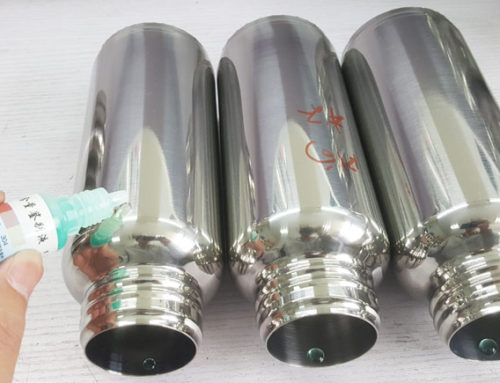
The interior should be electrolytically polished and bright. No water spots, no yellow stains, no discoloration.
Pattern / Decoration
If there’s a pattern or logo on the bottle, check that it’s clear, properly positioned, and matches the sample in size and placement.
For leather-covered bottles (like the NB350L or NB500L), check that the leather isn’t damaged, the stitching is even, the color matches the sample, and there’s no glue seepage.
Plastic Parts Quality
Plastic components need just as much attention as the metal parts:
**Handles** – No burrs on the edges. The surface should be free of scratches, bubbles, short shots, or obvious sink marks.
**Upper and lower rings** – The sandblasted surface should be uniform. No scratches, dents, short shots, or burrs.
**Lids** – No rough edges or burrs. The gloss should be consistent.
**Switches/buttons** – Should operate smoothly with no sticking. No rough edges, and the gloss should meet requirements.
Fit and Assembly – The Little Things That Matter
Even if every individual part looks perfect, they still need to work together:
– The lid and switch should thread onto the body smoothly. After filling with hot water and tightening, there should be no slipping.
– Plastic rings should fit tightly – no wobble.
– Steel lids and plastic lids should stay together – they shouldn’t separate.
– For telescopic handles (like on the XLB-120D), they should extend and retract smoothly.
Packaging Inspection – Don’t Overlook This
Bad packaging can ruin good products. Check:
– **Individual packaging** – Matches the order specifications
– **Inner boxes and master cartons** – Correct size, material, and construction
– **Carton markings** – Shipping marks, handling instructions, and product identification all correct
– **Barcodes** – Scannable and matches the product information
Different Products, Different Criteria
Not all insulated bottles are inspected the same way. Here’s the thing – a travel mug gets checked differently than a wide-mouth flask or a kids’ bottle.
For example:
– **Travel mugs** (like HYT850H-1) – Focus on switch operation and drinking comfort
– **Wide-mouth flasks** (like NS1000A-11) – Extra attention to the telescopic handle and lid alignment
– **Leather-covered bottles** – Special attention to leather quality and adhesion
– **Plastic-bodied bottles** (like NPC400A-18) – Check for sink marks and surface defects on the plastic shell
Make sure your inspection checklist matches the specific product type you’re buying.
The Bottom Line for s/s insulated water bottle inspection
Inspection isn’t just a box-ticking exercise. It’s your last line of defense before products go to your customers. A good inspection catches problems early – when they’re still fixable – rather than when containers are already on the water.
The key is knowing what to look for and having clear standards that both you and your supplier agree on upfront.
Need a Partner Who Takes Quality Seriously?
At Hono Housewares, we specialize in manufacturing high-quality stainless steel insulated water bottles. We’ve been in this business long enough to know what matters – and what doesn’t.
Our quality management system covers everything from raw material inspection to final pre-shipment checks. We work with international standards (EN, QB/T, KS) and can customize inspection criteria to match your specific requirements.
Whether you need travel mugs, wide-mouth flasks, or custom-designed bottles, we’re here to help you get it right – the first time.
Got a project in mind? Let’s talk. We’ll send you samples so you can see the quality for yourself.
Have questions about inspection criteria for a specific type of insulated water bottle? Drop us a message – we’re happy to share what we’ve learned over the years. For more detail information about inspection criteria for stainless steel insulated water bottle, you may visit the page: Support/Quality Criteria.