If you are sourcing custom stainless steel water bottles for corporate gifts, promotional campaigns or a private label program, laser engraving is probably on your list of logo options. For metal bottles it is usually the default choice, and there is a reason for that.
But laser engraving is not a “send us your logo and we will make it happen” kind of process. There are physical limits on how big the logo can be, and the color is not what most first time buyers expect.
We have seen a buyer approve a logo mockup and then open the production sample and go quiet. The logo was too wide. The edges were soft. And the mark was silver when he wanted black. None of that was a factory mistake. It was the process doing what the process does, and nobody had explained the limits before the order.
So this is the explanation. Size first, color second, and at the end the few things you should send us before you pay for anything.
Why metal bottles default to laser engraving logo
Laser marking does not sit on top of the surface the way a sticker or a screen print does. On a powder-coated bottle it burns the coating away and exposes the stainless steel underneath. It leaves nothing to peel or wash off in normal use, and there is no ink and no setup plate.
There is also a practical side that matters when you compare quotes. One bottle takes tens of seconds to mark once the jig is set. Small logos come out fine, down to a line width of about 0.05mm at best. In production we keep minimum strokes around 0.1mm so the mark stays the same from the first bottle to the last.
One clarification that saves arguments later. Laser is a metal process. If your artwork needs four colors, laser is the wrong tool, and the quote in your inbox is probably for UV printing, not laser.
The size limit nobody mentions in the quote
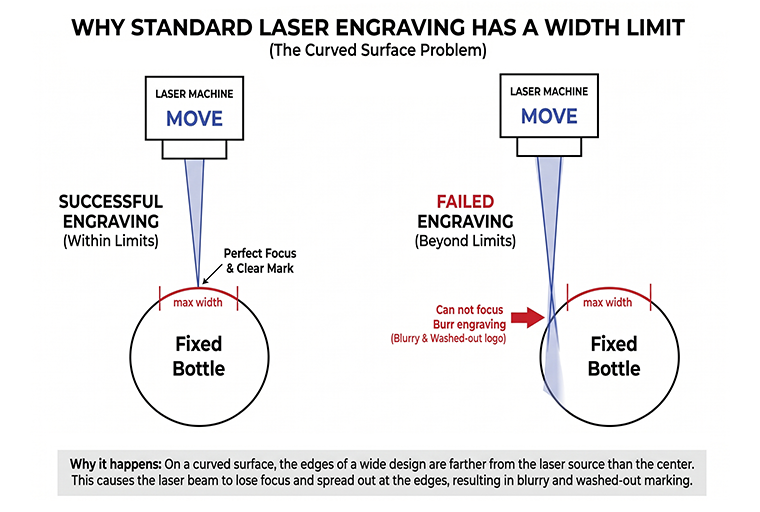
*Why wide logos blur at the edges. The center stays in focus, the sides do not.*
Put a bottle under a fixed laser head and the beam focuses on one flat plane. The bottle is not flat. At the center of the bottle the surface sits at the focal point. Move toward the sides and the surface curves away, so the beam arrives slightly out of focus. The spot grows, the energy density drops, and the mark turns gray and soft instead of crisp.
That is the whole reason for the width limit. It is not a marketing number.
In our standard setup the bottle stays fixed and the head moves. Working height goes up to about 13cm. Working width is a different story, usually 4.5cm to 6cm depending on the bottle.
The exact width comes down to the diameter. A wider bottle has a flatter curve near the center, so it tolerates a wider logo. This is the table we use on the floor:
| Bottle diameter | Max logo width |
| 65–72mm | 40–43mm |
| 72–80mm | 43–48mm |
| 80–88mm | 50–53mm |
| 89–95mm | 55–60mm |
| 100mm+ | 60–68mm |
Short version, if you only remember one line: keep the logo width under about 60% of the bottle diameter. A 75mm bottle takes roughly 45mm of logo. That is where the numbers in the table come from.
So if your logo is 80mm wide and the bottle is 75mm across, you have a decision to make. Shrink the logo, move it to the flat bottom, use a rotary fixture, or accept that the sides will look washed out. A factory that promises a crisp 80mm mark on a 75mm bottle without asking about the process is not doing you a favor.
If you are not sure which side of the line your artwork falls on, send us the logo width and the bottle diameter and we will check it before you commit to tooling. It takes a few minutes and saves a sample round.
When you need a wider laser engraving logo
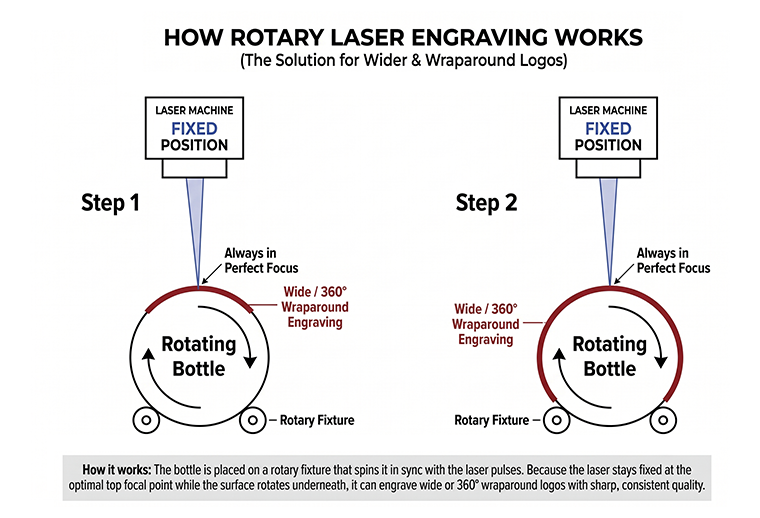
*A rotary fixture keeps the marked spot in focus while the bottle turns underneath.*
There are two ways out, and they cost differently.
The common one is a rotary fixture. The bottle sits on rollers, spins in sync with the laser pulses, and the head keeps marking the top of the curve, which is always at the focal point. You can go much wider this way, including a full 360 degree wrap. The trade off is speed, because the machine is now coordinating rotation and pulses, and a fixture has to be built for each bottle size. That is why we quote rotary work per job instead of per logo.
The other one is a 3D dynamic focus head, where the lens moves in the Z axis to follow the curve while the bottle stays still. It is faster than rotary on medium widths, and it costs more in equipment, so not every factory has one. Ask which of the two your supplier is quoting. The answer tells you a lot about the price.
For most corporate gift orders, the standard width is enough, and the logo looks better because it sits fully in focus. Full wrap designs are usually for retail brands that want the mark to be seen from the back of the shelf.
Why laser engraving logo will probably be silver
This is the part that surprises buyers most.
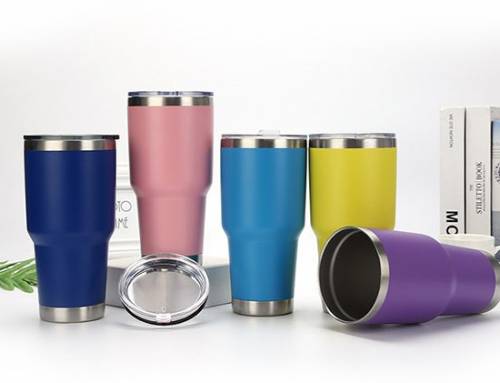
On a powder-coated bottle, the laser removes the coating and shows the bare steel. So the logo takes the color of the metal, which is a matte metallic gray. Not white, not black, and definitely not your brand color.
You cannot get a red or blue logo out of a standard laser on a coated bottle. If a supplier says they can do full color laser on a standard powder-coated bottle without any special process, ask which machine and which process. Most of the time they mean UV printing. That is a fine process, but it is not laser, and the durability is not the same.
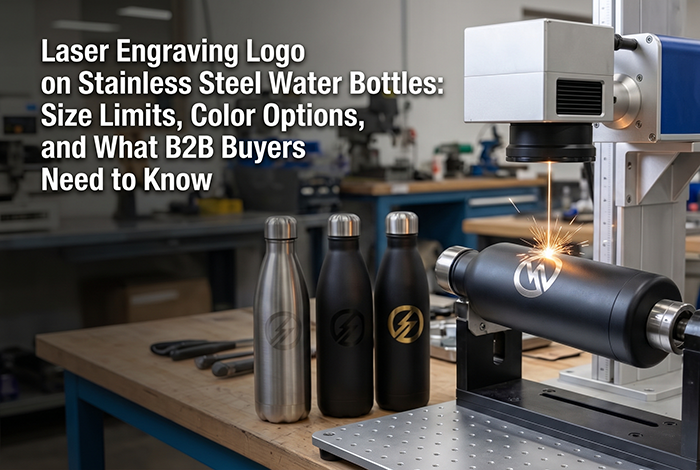
The hero image at the top of this page is the honest version of it: one bare steel bottle, one black coating, one gold plated body, and the laser cutting a silver mark into a fourth. Three preps, one machine.
Black and gold engraving logo, the two exceptions
Both are possible. Neither is a checkbox on a quote sheet.
Black laser
Black marking is usually done on a MOPA fiber laser with short pulses. Instead of removing material, the pulse builds an oxide layer on the steel, and that layer reads as dark gray to black.
Two things to know before you specify it.
The darkness depends on the alloy and the surface. 304 and 316 do not respond the same way, and a brushed finish marks differently from a polished one. A sample on your actual bottle matters here more than anywhere else in this article.
The heat also changes the metal. The heat-affected zone can lose some corrosion resistance, so if the bottle is going outdoors, on a boat, or into a salty market, ask for a salt spray result rather than a promise.
Gold laser
The laser does not print gold. The gold has to be there before the laser arrives.
The route we use is electroplate first, so the body carries a gold or rose gold layer, then powder coat over it. The laser is dialed in to cut only the coating, which exposes the plated metal in the shape of your logo. The result is a gold logo on a colored bottle, and it looks expensive because it is.
Two honest caveats. The plating is thin decorative plating, not armor. In a spot where hands rub all day, the gold will dull before the rest of the bottle does. And because you added a plating step, the unit price and the lead time both move up. Ask for the number before you design the whole collection around it.
Laser against the other logo methods
People search for this comparison for a reason, so here it is in one table. Cost is relative, not a quote.
| Method | Look | Colors | Durability | Best for |
| Standard laser | tone on tone, silver on coating | silver, gray | very good | premium gifts, small clean logos |
| Black or gold laser | high contrast | black, gold | good | retail brands, gift sets |
| Screen print | flat and opaque | any spot color | medium, chips at the edge | big colorful logos, promo volume |
| UV print | photo quality | full color, gradients | medium | multi color art, character designs |
| Water transfer | full wrap | full color | medium | all around prints on curves |
The short version. Laser wins on durability and on small marks. Printing wins on color and on large artwork. If your design has a gradient or a mascot, laser is not the answer no matter how wide the bottle is.
What to send us before you pay for anything
Three files and one number, and most of the risk disappears.
1. The logo as vector, meaning AI, EPS, PDF or SVG, with all fonts outlined. A JPG is fine for a quote and useless for production, because we cannot scale it without losing the edges.
2. The bottle model or the exact diameter, and where the logo sits: front, back, bottom, lid.
3. Quantity, target market and deadline. A gift order for June and a retail program for next spring take different routes.
Then ask for a marked sample on your actual bottle, not on a similar one. A digital mockup can lie. A physical sample cannot.
FAQ
Can laser engraving be removed?
No. Once the coating is burned away or the steel is marked, the mark is part of the bottle. If the logo changes later, you change the bottle, not the mark.
Will the engraved area rust?
On a coated bottle the mark is bare stainless, so it behaves like bare stainless. 304 is fine for normal use. For salt water, marine or heavy outdoor use, choose 316 and ask for a salt spray report.
Can you engrave the lid, the bottom or a curved logo?
Bottoms are flat, which makes them the easiest place for a wide mark. Lids are often plastic or a different coating, so they need a test first. A logo that wraps around the body needs a rotary fixture.
What is the smallest font you can engrave?
Around 5 to 6pt, with a cap height near 1.5mm, and only if the stroke is at least 0.1mm. Thin serif fonts and fine hairlines disappear at that size. Send the font and we will check it before tooling.
Is laser engraving more expensive than printing?
For small logos, per unit it is usually cheaper than screen printing, because there is no ink and no plate. Against UV printing it depends on the artwork. Black and gold cost more than standard laser, since they add passes or a plating step.
Can you match a Pantone color with laser?
No. Laser has no color. What you can match is the coating, and then the laser shows the metal through it. If the logo color is a brand requirement, plan for printing or for gold plating.
About Hono Housewares
Hono Housewares is a professional manufacturer of stainless steel insulated drinkwares in Zhejiang, China. Our site is honogo.com.
We have been doing custom logo work on stainless steel bottles for more than fourteen years, including standard laser, black laser and the plated gold process. Our custom printing team handles the artwork check, the surface finish and the sample, and our QC follows the order through to packing against the quality criteria you sign off.
We will tell you straight if your design needs to change. That is cheaper for both of us than a rework.
Let’s check your logo before you order
Send us your logo file and the bottle diameter you are using. We will tell you within one working day whether the width fits standard laser, and if you want to see the real color, we will send a marked sample on your bottle.
– Email: info@honogo.com
– Or the form on our contact page
Mention this article and tell us the bottle size. It saves a round of questions.