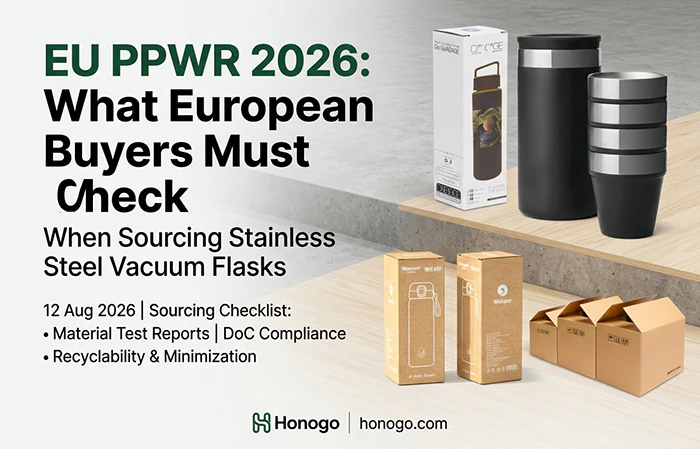
If you’re a European buyer sourcing stainless steel vacuum flasks, tumblers, or thermal mugs from Asia – especially China – you need to read this. The new EU Packaging and Packaging Waste Regulation (PPWR) officially kicked in on 12 August 2026. And it’s not just your supplier’s problem. It’s yours too.
Here’s the deal: PPWR applies to all packaging placed on the EU market – retail cartons, inserts, polybags, outer shipping boxes, tape, labels, even the ink on the box. If your supplier ships products without proper compliance documents, your shipment can be stopped at customs. And guess who’s responsible? You, the importer.
So before you place your next order, here’s what you need to check with your supplier – and what you should ask for.
1. The “Must-Have” Test Reports
Your supplier should provide third-party test reports** for every packaging component. Don’t accept a generic RoHS report for the flask itself – that doesn’t cover packaging.
Heavy Metals – The Basic Gatekeeper
Every homogeneous material in the packaging (carton board, ink, adhesive, coating, plastic insert) must have the total concentration of **lead, cadmium, mercury, and hexavalent chromium ≤ 100 mg/kg (100 ppm). This is non-negotiable. Ask your supplier to show you separate test results for each material – different ink colours, different plastic types – they all need their own tests.
PFAS – If Your Packaging Touches the Flask Mouth
If the inner packaging or carton directly contacts the part that touches your lips, it might be considered **food-contact packaging**. PFAS limits apply:
– Non-polymer PFAS sum ≤ 250 ppb
– Each individual non-polymer PFAS ≤ 25 ppb
– Total fluorine (including polymer) ≤ 50 ppm
A practical approach: ask for a total organic fluorine (TOF) screening first. If it passes, you’re safe on PFAS without chasing every single substance.
2. Declaration of Conformity (DoC) – Not Optional
Since 12 August 2026, every packaging type must have a valid DoC and technical file before it can be sold in the EU. The DoC is not a CE mark – it’s a standalone document with 10 mandatory items per Annex VIII of the regulation.
When reviewing your supplier’s DoC, check these points:
– Is there a unique identification number?
– Does it clearly identify the **packaging** (type, SKU, components)?
– Does it state the manufacturer’s name and address (and EU authorised representative if any)?
– Does it list the **applicable standards** and reference test results?
– Is it **signed and dated** by a responsible person?
No DoC? No shipment. Simple as that.
Keep the DoC and all technical documents for at least 5 years (10 years for reusable packaging). Customs can ask for them within 10 working days – you need to be able to produce them immediately.
3. Recyclability and Design Rules – Hidden Traps
From August 2026, all packaging must be recyclable (at least Grade C, meaning 70% recyclable). And from 2030, only Grade C or above can stay on the market.
Also, there’s a packaging minimisation rule**: empty space inside the box cannot exceed 40% of the total volume. So if your flask box looks fancy but is mostly air, that could be a problem.
Ask your supplier:
– Do they have a recyclability assessment** for each packaging design?
– Can they prove the packaging weight and volume are minimised to the functional minimum?
4. Labelling – Easy to Overlook
Every packaging must carry a type, batch, or serial number for traceability, plus the manufacturer’s name, trademark, postal address, and electronic contact. From 2028, material composition labels (like recycling symbols) will also become mandatory.
Make sure your supplier’s packaging artwork includes this information – otherwise, it’s non-compliant at the retail shelf.
5. EPR Registration – Your Own Responsibility
Even if your supplier provides all the above, you as the importer still need to register for Extended Producer Responsibility (EPR) in each EU member state where you sell. PPWR separates product compliance (supplier’s job) from financial responsibility (your job). Don’t forget this – each country has its own registration system and fees.
What Should You Ask Your Supplier Right Now?
Here’s a simple checklist to copy-paste into your next email to your flask manufacturer:
1. Please provide heavy metal test reports for all packaging components (carton, insert, polybag, outer box, tape, label). Each material/colour separate.
2. If the inner packaging touches the flask mouth, please provide TOF or PFAS test.
3. Please provide the DoC in the format required by PPWR Annex VIII, along with full technical documentation.
4. Please confirm the packaging recyclability grade and provide supporting assessment.
5. Please confirm that packaging volume meets the ≤40% empty space rule.
6. Please ensure the packaging artwork includes traceability number and manufacturer contact.
If your supplier cannot provide these documents – honestly, you should think twice before shipping. Customs in Rotterdam, Hamburg, or Antwerp are already checking. Don’t let your container sit there waiting for paperwork.
Why Hono Housewares?
At Hono, we work with European buyers every day. We understand that PPWR is new and confusing, and we’ve already helped many of our customers get their packaging compliant – from material testing to DoC preparation. We can provide all the documents you need, and we can even help you review your packaging designs before production.
If you’re sourcing stainless steel vacuum flasks and want to avoid customs headaches, talk to us. We’ll make sure your order arrives smoothly.