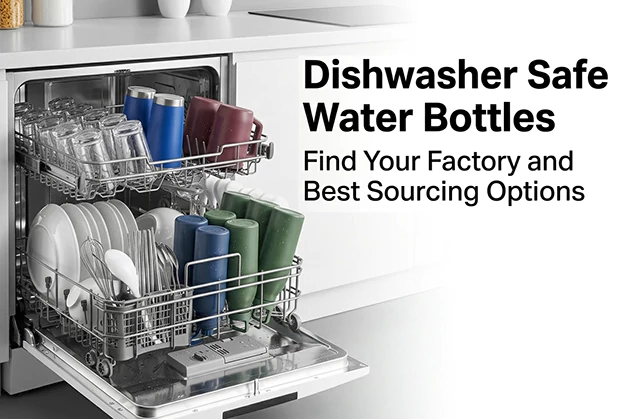
If you are sourcing stainless steel insulated water bottles for the European or American market, you have probably heard this question from your clients: “Are these bottles dishwasher safe?” Ten years ago, this was hardly a concern. Today, it is almost a standard requirement. More and more consumers use dishwashers to clean their drinkware, and they expect their bottles to survive the process. But passing dishwasher testing is not as simple as it sounds — especially for powder-coated bottles. Let us break down what the test involves, why most bottles fail, and how to source products that actually pass.
What Does Dishwasher Testing Actually Require?
A standard dishwasher test is not just one quick wash. It typically requires **10 to 30 consecutive cycles** in a household dishwasher. Each cycle runs for about 55 to 90 minutes, using high-temperature water (65°C ± 12°C during wash, 80-85°C during rinse) and standard dishwasher detergent. The bottle must survive repeated exposure to heat, water pressure, and aggressive chemicals without showing any noticeable color change, peeling, cracking, or loss of insulation performance.
What Needs to Be Tested?
Dishwasher testing covers three critical areas:
– Component tolerance: Plastic lids and silicone sealing rings must not deform, crack, or release odors under repeated high heat. Otherwise, the seal fails and food safety becomes a concern.
– Coating chemical resistance: The powder coating or paint must withstand dishwasher detergents and hot water (70°C+) without bubbling, peeling, or discoloration.
– Coating durability: After 30 cycles (each about 60 minutes), the coating should maintain over 90% gloss retention with no chalking or fading.
Why Do Most Powder-Coated Bottles Fail the Test?
Here is the truth: many powder-coated water bottles on the market simply cannot pass dishwasher testing.
The main reason is the powder material itself. Most manufacturers use standard powder coatings that are not heat-resistant. These powders have a low glass transition temperature (Tg) — typically around 80°C. When exposed to 70°C+ dishwasher environments, the coating softens and becomes vulnerable.
But there is another problem. Powder coating is granular by nature, creating a slightly rough, matte surface with tiny凹凸不平. During dishwasher cycles, detergent residue gets trapped in these microscopic gaps. The high temperature (70°C+) causes the residue to chemically attack the coating over time. After multiple cycles, the surface develops a white, foggy, mottled appearance — like a layer of frost. In severe cases, the coating powders, flakes, or develops fine cracks.
How to Make Powder-Coated Bottles Dishwasher Safe
The solution is not complicated, but it requires discipline and the right materials:
1. Use high-temperature resistant powder
Replace standard powder with dishwasher-grade “high-performance epoxy” or “super-durable polyester” powder. Focus on the Tg (glass transition temperature) — choose powders with Tg above 120°C for better heat resistance. Yes, it costs a few thousand more per ton, but it will save your orders.
2. Control coating thickness
The ideal powder coating thickness is 60-80μm. Too thin, and it does not provide enough protection. Too thick, and internal stress builds up, leading to cracking.
3. Optimize curing conditions
This is absolutely critical. Many failures come from incomplete curing. Use an oven temperature tracker to verify that the actual temperature of the cup body reaches and maintains around 200°C for no less than 12 minutes. If the temperature is too low or the time too short, the powder will not fully cross-link, and it will fail as soon as it hits the dishwasher.
Hono’s Experience with Dishwasher Safe Water Bottle
At Hono Housewares, we have extensive experience producing insulated water bottles that pass dishwasher testing. We use specialized dishwasher-grade powder coatings and strictly control every step of the process — from pre-treatment and spraying to curing and thickness measurement. Our quality control team performs regular dishwasher tests to ensure consistency batch after batch.
If you are looking to source stainless steel insulated water bottles that can truly stand up to the dishwasher, do not leave it to chance. Work with a supplier who understands the technical requirements and has the production capability to deliver.
Contact Hono today to discuss your dishwasher-safe water bottle needs. We are ready to provide samples, test reports, and competitive solutions for your market.
Reach out now — quality that survives the wash.