
Custom & Unique Shaped Stainless Steel Water Bottles DFM Engineering & Manufacturing Guide
I. Introduction: The Concept Trend vs. Engineering Realities
In today's highly competitive global drinkware market, aesthetic homogenization has become a major challenge for North American and European brands, DTC startups, and outdoor gear companies. To stand out on Amazon, Shopify storefronts, or retail shelves, product designers and brand R&D teams are increasingly pushing beyond standard cylindrical profiles to introduce eye-catching non-cylindrical vacuum bottles. These include bold square/rectangular water bottles, retro pocket-friendly flat hip flasks, stream-lined gourds or multi-faceted prisms, and even dual-compartment insulated bottles.
However, as a specialized OEM/ODM manufacturer with over a decade of experience in stainless steel vacuum container production, our engineering team at Honogo frequently encounters a common dilemma when reviewing CAD files, 3D renderings, and STP models from overseas clients: the design concept is visually striking with fantastic marketing potential, but during the Design for Manufacturability (DFM) assessment, it faces severe roadblocks—exorbitant tooling costs, low mass-production yields, or structural vacuum collapse.
Why are 99% of mass-market vacuum insulated bottles still cylindrical? Where do the actual engineering bottlenecks lie for unique shapes? If a brand is determined to launch a non-cylindrical insulated bottle, what are the viable engineering alternatives and cost-control strategies? This technical white paper provides a comprehensive breakdown from the perspective of metal forming mechanics, vacuum physics, and industrial production.
II. Industrial Fundamentals: Why Are 99% of Vacuum Bottles Cylindrical?
The geometry of a vacuum bottle is not dictated merely by designer preference, but by fundamental material mechanics, automated machining efficiency, and vacuum physics. Cylindrical shapes represent the "golden standard" of drinkware manufacturing due to six core advantages:
- Material & Hydroforming Compatibility:
Standard inner liners and outer shells start as seamless or welded circular stainless steel tubes (SUS304 or SUS316). During hydroforming, high-pressure liquid applies uniform radial force against the tube wall, resulting in an even 360-degree stress distribution and uniform wall elongation without localized weak points or tearing. - High-Speed Machining & Spinning Efficiency:
Secondary metalworking operations—such as necking, thread rolling, edge trimming, facing, and spinning—rely on rotational symmetry. Workpieces can be mounted on high-speed rotating spindles where tools move linearly along the radial or axial direction, enabling up to 99% automated processing. - Consistent Circumferential Welding:
Joining the inner liner to the outer shell at the bottle neck relies on circumferential TIG (Tungsten Inert Gas) or high-power fiber laser welding. The welding head remains stationary while the workpiece rotates uniformly, yielding clean, continuous, and defect-free airtight welds. - Optimal Vacuum Structural Mechanics:
Vacuum insulation requires a high vacuum layer between the inner liner and outer shell. Under a full 1 atmosphere of external negative pressure , a cylindrical structure converts external pressure into uniform hoop stress, offering the highest resistance to structural buckling or collapse for thin-walled steel . - Automated Surface Finishing & Decoration:
Downstream processes—including centerless polishing, automated electrostatic spray painting, screen printing, heat transfer printing, and 360-degree rotary laser engraving—are naturally optimized for rotating cylindrical bodies, minimizing cycle time. - Economies of Scale & Mature Supply Chain:
The global drinkware supply chain is built around standard cylindrical automation. Shared tooling, low scrap rates, and high throughput keep FOB unit costs at an absolute minimum.
III. Technical Breakdown & DFM Solutions for 7 Non-Cylindrical Bottle Designs
Despite the manufacturing advantages of cylindrical bottles, non-cylindrical designs offer powerful market differentiation. Below is an engineering feasibility analysis of seven popular non-cylindrical designs:
3.1 Unique / Curved Bottles (Gourd-Shaped, Prism, Waist-Contoured)
- Description: Curved or contoured bottle bodies featuring narrow waistlines, multi-faceted prism facets, or stream-lined silhouettes.
- Selling Points: High brand recognition, distinct hand-feel, premium aesthetic appeal.
- Technical Challenges:
- Hydroforming Expansion Limit: SUS304 tube expansion is typically limited to 30%–35%. Excessive radial variation causes severe wall thinning and material bursting.
- Liner Assembly Bottleneck: In standard assembly, a straight cylindrical inner liner is inserted from the bottom of the outer shell. A narrow-waist outer shell prevents inner liner insertion.
- Engineering Solutions:
Apply multi-stage hydroforming with intermediate bright annealing in a vacuum furnace to relieve work hardening. For narrow-waist outer shells, utilize a split-shell design (front/back or top/bottom stampings), insert the inner liner, execute multi-axis laser seam welding, and perform secondary high-pressure hydroforming calibration.
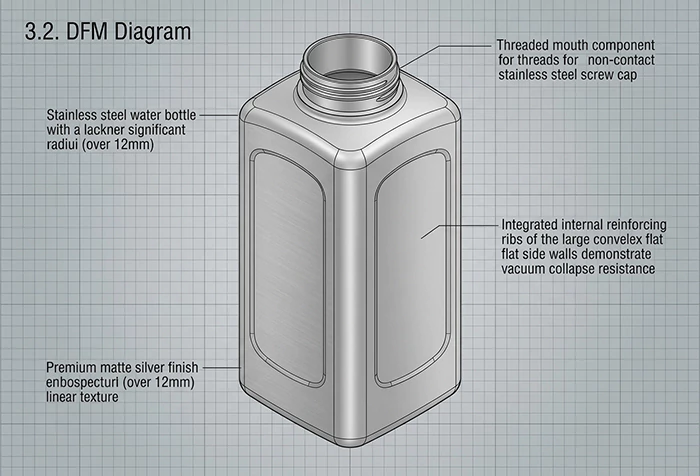
3.2 Square & Rectangular Water Bottles
- Description: Square or rectangular cross-section bottle bodies with clean edges or small corner radii.
- Selling Points: Modern architectural aesthetic, high space efficiency in backpacks/crates, non-rolling functionality.
- Technical Challenges:
- Corner Stress Concentration: Square bodies cannot be hydroformed directly from circular tubes; they require multi-stage deep drawing from sheet metal, where small corner radii ($R$) suffer extreme shear stress and tearing.
- Vacuum Side-Wall Collapse: Flat side walls lack geometric stiffness. Under 101 kPa external atmospheric pressure, flat surfaces buckle inward, causing inner and outer liners to touch, resulting in thermal loss.
- Transition to Round Threaded Mouth: A circular threaded mouth is essential for leak-proof sealing, but transitioning a square shoulder to a round neck creates complex 3D welding seams.
- Engineering Solutions:
- Enlarge corner radii to $R \ge 12\text – 15\text$ to prevent stress concentration.
- Incorporate $2^\circ – 5^\circ$ outward convex curvatures or internal reinforcing ribs onto flat walls to convert bending stress into membrane compressive stress.
- Pre-stamp separate circular neck components and join them to square shoulders using multi-axis 3D laser trajectory welding.
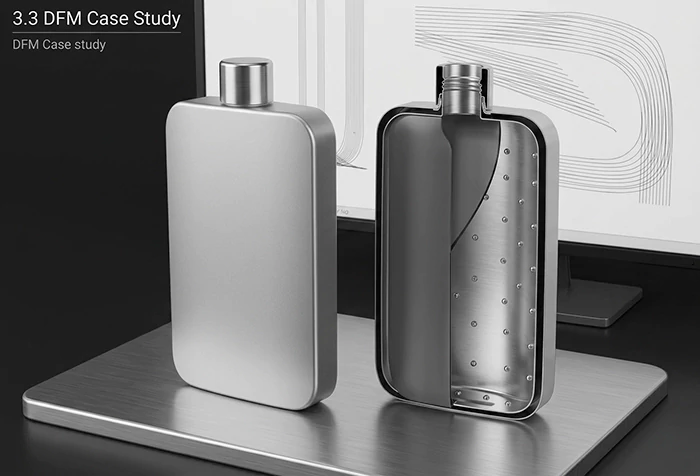
3.3 Flat / Hip Flask Style Pocket Insulated Bottles
- Description: Slim, flat profile (3cm–5cm depth), often contoured to fit pockets or body curves.
- Selling Points: Extreme portability, easily slipping into jacket pockets, suit linings, or slim bags.
- Technical Challenges:
- Severe Inward Vacuum Buckling: Large parallel flat faces collapse inward under vacuum, touching the inner liner and instantly destroying thermal insulation.
- Non-Circular Welding Trajectory: Oval or rectangular bottom and neck seams cannot be welded on standard rotary welding equipment.
- Engineering Solutions:
- Design $2^\circ – 5^\circ$ convex profiles across front and rear faces (arch principle).
- Integrate internal spot-welded vacuum spacer pillars/dots between inner and outer liners to prevent contact.
- Utilize custom 5-axis robotic laser welding for non-circular seam tracking.
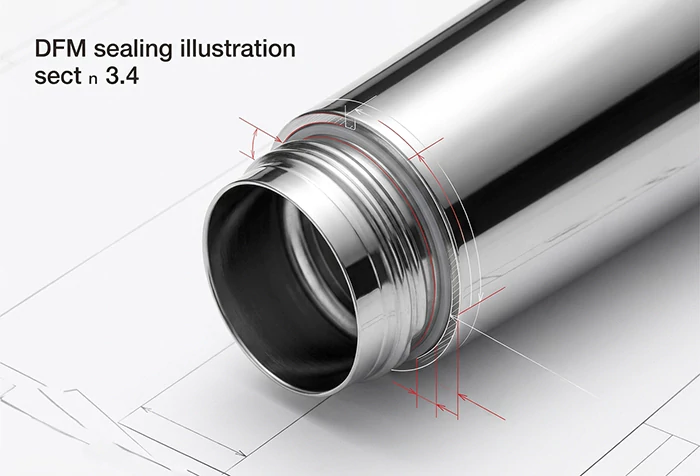
3.4 Plastic-Free All-Steel Bottles
- Description: 100% plastic-free and silicone-free design where body, lid core, threads, and handle are entirely stainless steel.
- Selling Points: Zero plastics, zero microplastics, zero phthalates, ultimate eco-friendly purity.
- Technical Challenges:
- Hard-to-Hard Sealing Micro-Leaks: Rigid steel lacks elastic deformation; micro-roughness on metal surfaces allows fluid or gas seepage under inversion.
- Thread Galling / Seizing: Friction between identical stainless steel grades (e.g., 304 on 304) causes localized cold welding, thread seizing, and metal particulate shedding.
- Engineering Solutions (DFM Compromise Strategy):
Implement a "Water-Contact All-Steel" architecture. The lid core exposed to liquid is deep-drawn 304/316 stainless steel. A food-grade/medical-grade silicone O-ring is embedded in a hidden groove above the threads outside the water contact zone. This maintains 100% leak-proof reliability and prevents thread galling while ensuring water never touches plastic.
3.5 Split Double-Section Modular Bottles
- Description: Bottle body splits horizontally into two sections via mid-body threaded coupling.
- Selling Points: Wide-mouth access for easy cleaning and adding large ice cubes; dual-use as a short tumbler or full bottle.
- Technical Challenges:
- Vacuum Exhaust Bottleneck: The upper section is open at both ends, rendering standard bottom-tubulation vacuum exhaust inapplicable.
- Mid-Section Thread Friction & Alignment: Large-diameter steel threads create harsh friction noise, and manufacturing tolerances often cause graphic/logo misalignment when tightened.
- Thermal Bridge at Mid-Joint: Metal-to-metal coupling creates a thermal path, reducing insulation performance.
- Engineering Solutions:
- Apply top/bottom circumferential laser deep penetration welding on the upper section and seal the vacuum via hidden laser dot welding in the wall gap.
- Use ACME trapezoidal threads with PVD anti-friction coating or electropolishing.
- Incorporate an embedded dual-lip silicone gasket and an alignment locking pin to ensure exact logo orientation upon tightening.
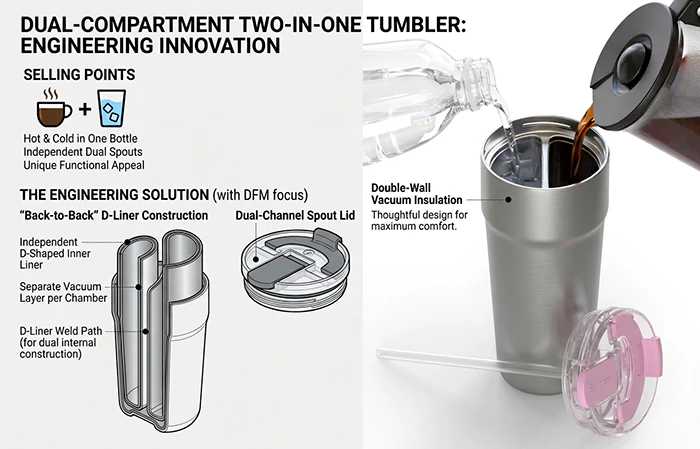
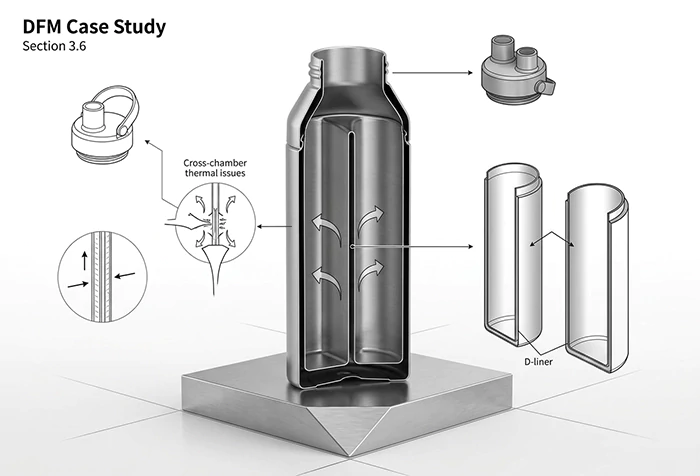
3.6 Dual-Compartment / Two-in-One Bottles
- Description: A single bottle split vertically into two separate interior chambers (e.g., hot coffee in left, iced water in right).
- Selling Points: Two drinks in one bottle, dual drinking spouts, unique functional appeal.
- Technical Challenges:
- Deep Drawing Limits: Single-tube hydroforming cannot create an internal wall; stamping two D-shaped inner liners results in extreme draw ratios and divider splitting.
- Cross-Chamber Thermal Conduction: A single-wall central divider quickly equalizes temperature between hot and cold chambers.
- Cross-Leakage & Flavor Transfer: Any micro-pinholes in central welds result in liquid mixing.
- Engineering Solutions:
Manufacture two independent D-shaped double-wall vacuum inner liners "back-to-back" and assemble them inside a single outer protective casing. Top with a dual-channel independent spout lid.
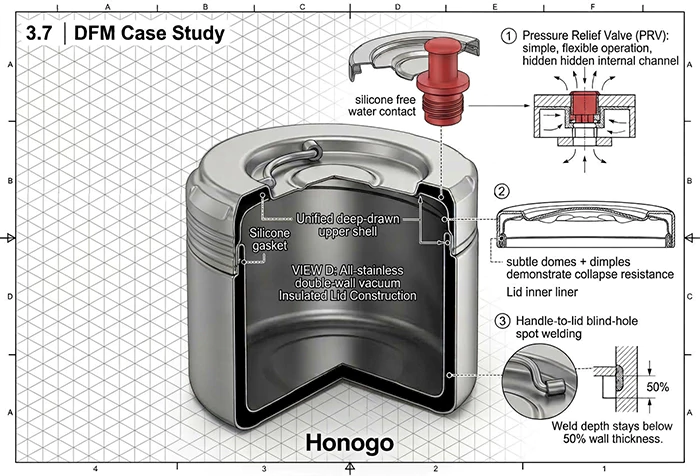
3.7 All-Steel Double-Wall Vacuum Lunch Box Lids
- Description: Low-profile wide-mouth soup/food jars featuring an all-stainless double-wall vacuum insulated lid.
- Selling Points: Eliminates heat loss through plastic caps, offering superior heat retention and all-metal durability.
- Technical Challenges:
- Thermal Vacuum Lock: Cooling hot food creates a negative pressure lock inside the jar, making rigid steel lids impossible to unscrew by hand.
- Lid Bottom Buckling: Large-diameter flat lid bottoms collapse under vacuum.
- Handle Spot-Weld Punctures: Heavy-duty handle welds risk puncturing thin vacuum walls.
- Engineering Solutions:
- Integrate a push-button pressure relief valve (PRV) into the lid core to equalize pressure prior to opening.
- Stamp a slightly domed profile with reinforcing dimples on the lid inner liner.
- Perform high-power laser blind-hole spot welding for handles, ensuring weld depth stays below 50% wall thickness.
IV. Summary & DFM Comparison Matrix
| Bottle Design | Key Selling Points | Primary Technical Bottlenecks | Recommended Engineering Solutions | DFM Rating |
| Curved / Gourd | High visual identity, premium aesthetics | Hydroforming limit; inner liner fitment issues | Multi-stage hydro + annealing; split outer shell | ★★★☆☆ |
| Square / Rectangular | Modern look, non-rolling, space-efficient | Corner cracking; flat wall vacuum collapse | Corner; convex wall + ribs | ★★★☆☆ |
| Flat / Hip Flask | Pocket-friendly, highly portable | Inward wall buckling; complex welding | Convex faces; internal spacers | ★★★★☆ |
| Plastic-Free All-Steel | 100% plastic-free, eco-friendly purity | Metal-on-metal leakage; thread galling | Water-contact steel + hidden silicone O-ring | ★★★★★ |
| Split Double-Section | Easy cleaning, modular dual-use | Open-top vacuuming; thread alignment | Hidden laser dot sealing; ACME threads + PVD | ★★★☆☆ |
| Dual-Compartment | Two drinks in one, dual spouts | D-liner tearing; cross-chamber thermal bridge | Back-to-back independent vacuum liners | ★★☆☆☆ |
| All-Steel Vacuum Lid | Maximum retention, all-metal durability | Thermal vacuum lock; face collapse | Pressure relief valve (PRV); domed liner | ★★★★☆ |
V. Mass Production Cost & Risk Assessment
Developing a non-cylindrical vacuum bottle requires evaluating commercial viability alongside technical feasibility. Four hidden cost factors must be considered:
- Tooling & Fixture Costs ($30,000 – $80,000+):
Standard cylindrical bottles require basic stamping and hydroforming dies ($5,000 – $10,000). Non-cylindrical bottles require multi-stage deep drawing dies, vacuum annealing fixtures, 3D laser welding positioning jigs, and custom inspection gauges, extending lead times to 60–90 days. - Yield Rate Drop & Scrap Costs:
Mass-production yields for standard bottles exceed 96%–98%. Non-cylindrical bottles initially yield 60%–80% due to corner cracking, laser seam porosity, or vacuum collapse, inflating unit FOB prices by 40%–100%. - Reduced Labor & Automation Efficiency:
Non-cylindrical shapes cannot utilize automatic centerless polishing or rotary spray painting lines, requiring manual loading/unloading and multi-pass grinding, which increases unit labor man-hours. - Setup Costs & Higher MOQ Thresholds:
Machinery recalibration and trial run scrap for non-circular welding and hydroforming are substantial. Factories typically require higher MOQs (5,000 – 10,000 units) to amortize setup costs.
VI. Hono's DFM Golden Rules for Overseas Product Managers & Designers
To balance aesthetics, functionality, and manufacturability while controlling costs, Hono recommends four DFM golden rules:
- Rule 1: Adhere to "Round Mouth, Shaped Body" Architecture
Keep bottle mouths and thread zones strictly circular. Transition to square, flat, or polygonal geometry below the neck. This preserves standard leak-proof thread performance while delivering distinct body aesthetics. - Rule 2: Replace Absolute Flat Surfaces with Subtle Convex Curvatures & Ribs
Avoid 100% flat geometric faces in 3D CAD. Apply $2^\circ – 5^\circ$ outward convex curves or embossed reinforcing ribs. Convex surfaces increase vacuum collapse resistance by over 300%. - Rule 3: Adopt "Standard Vacuum Liner + Shaped Outer Shell" Modular Strategy
For lower tooling budgets and smaller MOQs, pair a standard cylindrical double-wall vacuum inner container with a custom stamped, molded, or extruded outer sleeve (aluminum, silicone, or zinc alloy). This isolates thermal engineering from exterior styling. - Rule 4: Conduct FEA Simulation & Hydroforming Modeling Prior to Tooling
Utilize 3D Finite Element Analysis (FEA) and hydroforming simulations to detect material thinning, stress concentration, and vacuum deformation points before cutting steel molds.
VII. Conclusion & Technical Support from Hono
Manufacturing custom non-cylindrical stainless steel vacuum bottles requires specialized metallurgy experience, multi-axis welding precision, and thorough DFM planning. A successful commercial product represents a balance between design vision, user experience, physical laws, and unit cost.
As an established OEM/ODM manufacturer specializing in high-grade stainless steel vacuum drinkware, Hangzhou Herong Housewares Co., Ltd. / Hangzhou Hono Housewares Co., Ltd. operates complete R&D and manufacturing facilities. Our engineering team bridges the gap between creative design concepts and reliable mass production.
If you are planning to develop a custom square water bottle, flat pocket flask, plastic-free thermal container, or unique shape insulated bottle, contact Honogo's engineering team for complete technical support—from CAD review and DFM optimization to FEA simulation, prototyping, and mass production.
Contact Hono Engineering Team
- Official Website: https://honogo.com
- Business & Engineering Inquiries: sales@honogo.com | info@honogo.com
- Core Expertise: Stainless Steel Vacuum Bottles, Non-Cylindrical Thermal Flasks, Outdoor Drinkware, OEM/ODM Tooling & DFM Services